
Dabblers
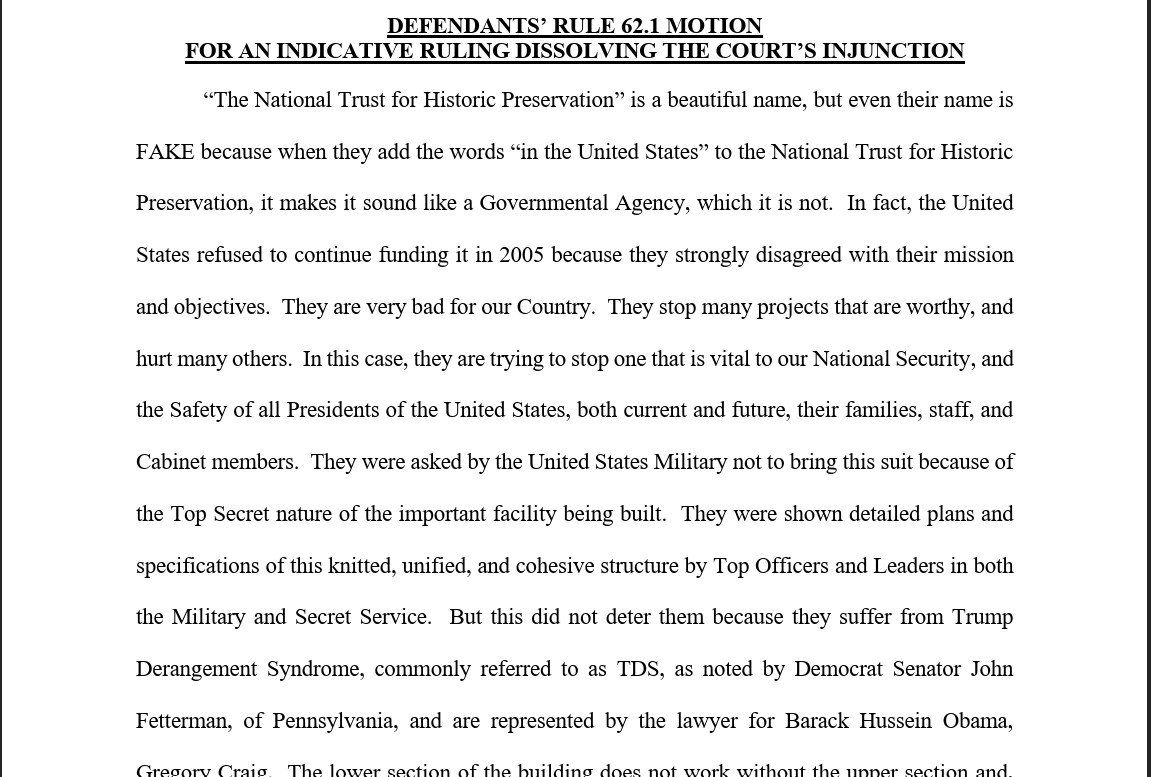
Last week, attorneys for DOJ filed a motion in federal court — a Defendants’ Rule 62.1 Motion for an Indicative Ruling Dissolving the Court’s Injunction — that has been universally and justly described as something closer to an eighth grader’s fever dream of what a legal brief is than, well, a real brief. It accused the opposing party of suffering from “Trump Derangement Syndrome,” cited a Democratic senator’s use of that phrase as legal authority, referred to the plaintiff’s organization’s name as “FAKE,” and invoked national security, the Secret Service, and Top Officers in a single breathless run-on paragraph. It tossed everything in except a legitimate legal argument on the issues presented in the original filing. It was derided by legal commentators across the political spectrum not as advocacy, but as an embarrassment to the profession.
Reading it, I could only think of one thing.
“Dabblers.”
“Dabbler” is the term for a lawyer who takes a case well outside their actual area of expertise. Lawyers are technically licensed to handle any matter they choose once they pass the bar. There is no formal requirement to train in a specialized area before hanging out a shingle—a fact we should be profoundly grateful for, because the alternative is the medical model. Imagine your orthopedic surgeon finishes examining your MCL repair, smiles up at you, and says, “This looks great — now let’s take a look at that toothache.”
This can and does, metaphorically, happen often in law practice. Sometimes it works out fine — a lawyer helps a friend through a simple closing, reads a simple contract. Simple being the operative word.
For reasons that are never quite valid, some lawyers take on matters they are not experienced enough to handle. They then compound the problem by doing whatever the client demands—because they’ve bought into the very dated adage that the customer is always right, or because the client holds a powerful position, or because the client is an authority in their own field and cannot quite grasp that being an authority in one field does not make you one in law.
Recently, a law school professor in Virginia provided a masterclass in how badly this can go.
The professor filed a $108 million defamation action against two former students who had previously filed Title IX complaints against him. The defamation suit was filed by the same firm already defending him on the Title IX matter.
The complaint—all twenty-six pages of it—did not rebut the Title IX allegations. It admitted them. The married, two-children professor had, the filing acknowledged, carried on affairs with both first-year law students. Their motive for filing the Title IX action, the complaint helpfully explained, was that they were upset upon learning he was simultaneously involved with a third student.
This had been a quiet matter, well beneath the legal headline horizon. Until the defamation case was filed. Then it most emphatically was no longer quiet.
Above The Law put it best: “Honestly, it’s difficult to imagine a more reputationally damaging account than the one Wright and his lawyers chose to lay out here. Because reading this complaint in the light most favorable to the plaintiff… he’s telling the world that he’s a[n idiot].”
They used a rather more direct word than “idiot.” But you get the point.
The professor justified the $108 million figure by claiming the two women had done irreparable harm to his reputation and future “marketability.” If so, the complaint finished the job.
The firm that filed it had no experience in defamation law. The lead attorney was a tech lawyer. Did anyone at the firm warn the professor about the many pitfalls of what he was demanding? Would he have listened if they had? Would the firm have filed it at all if the professor didn’t have the deep pockets—and the connections—to fund the ongoing action?
Who knows.
What we do know is that the Title IX complaints, which had been quietly pending, were fast tracked as the defamation filing handed the other side everything they needed to prove he violated the basic tenet of ‘it’s not the ‘70s, don’t date students.’
The thing about dabblers is that the damage rarely stays contained to the case itself. It spreads. One single filing that was meant to restore a reputation instead became the instrument of its destruction, and did so publicly, permanently, and in the professor’s own words.
Hire lawyers who know their field.
Intimately.
Update to “Zappos-ed”

Last month we wrote about a bizare probate saga — the $500 million estate of Zappos founder Tony Hsieh, who died in 2020 without a will, only to have a mysterious seven-page document surface years later, mailed from an untraceable source, witnessed by people who apparently don’t exist, and naming beneficiaries—including something called the Tony Hsieh Lit Wow Irrevocable Trust—that no one can find any record of.
Whew. It’s a lot.
A Nevada judge called the whole thing “just odd,” and then, because Nevada’s threshold for probate consideration is surprisingly low, ordered a trial. The Hsieh family has been fighting it ever since, with a linguistics professor, a handwriting expert, and a probate attorney all lined up to argue the document is a forgery.
Now the fight is going forensic.
Attorneys for Hsieh’s father filed court papers last week seeking approval to conduct CSI-style testing on the document itself. The testing, described as “semi-destructive” but not actually destructive, would involve taking pinhole-sized samples of ink and paper. From those samples, examiners can determine who manufactured the ink, when it was made, and how long it has been on the page. That last point is the key one: the will is dated 2015, and the testing would help establish whether the ink actually went on the paper around that time… or considerably later.
According to the filing, the physical and material characteristics of the document “are critical to confirming its invalidity.” The samples would be collected at the courthouse and analyzed off-site. The legal team was careful to note that the testing would not affect the document’s legibility, its evidentiary value, or anyone else’s ability to run their own tests.
As probate battles go, this one keeps finding new depths. The core lesson (have a will, tell people you have one, tell them where it is) hasn’t changed. But the Hsieh case is a useful reminder of a corollary: the absence of a real will doesn’t just create confusion. It creates opportunity. For fraudsters, for opportunists, for anyone willing to fill a vacuum with paperwork and hope no one looks too close.
Someone, it turns out, is looking very closely indeed. With a microscope.
For All Mankind
(but read the fine print first)

For All Mankind is an alternate history series on Apple TV+ built on a single premise: what if the Soviet Union, not the United States, had landed on the Moon first? From there on the butterfly effect is in full force. The show traces fifty years of consequences: political, technological, culture, sports (see the SI cover above, a cruel shot at Red Sox fans in our real time). It is among the better things on television, and has been since its debut in 2019.
Season Four launched in 2023 with a different focus, more on ‘regular people’ than astronauts and techies. That has carried over to the new season that started a few weeks ago.
Since early in season four, the plot has most relied on a most definitely non-space issue: a contract clause. Really.
Mars has been colonized inasmuch that there is now a large, working community on it called Happy Valley. Happy Valley needed workers, lots of workers. The new characters are contract workers. Mechanics. Fuel technicians. They are recruited from a depleted Earth economy with promises of premium pay, a sense of purpose, and a chance to stand on the actual surface of Mars. Miles Dale (a laid-off oil rig worker trying to keep his family solvent) signs up, makes the eight-month trip, and arrives at Happy Valley Base. He is immediately sent underground, into quarters shared with the rest of the blue-collar workforce, below the scientists and mission personnel who occupy the better levels above. He works virtually non-stop secure in the knowledge the overtime is piling up and his family will be moving to a nicer home.
Then he reads his pay stub.
He is making less on Mars than he made on Earth. Considerably less. The bonuses and premium pay that got him onto the rocket were changed according to a clause buried in the contract. It allowed Helios, the private company running the Mars operation, to modify employment terms as “conditions warrant.” Hostile environment. Operational necessity. Circumstances beyond the company’s control.
Mars qualified on all counts. Mars would always qualify.
By Season Five, a second clause surfaces. The workers had also waived their constitutional rights to free speech and unwarranted searches as a condition of employment. That was buried even deeper in the contracts.
But a unilateral modification clause tied to a catch-all condition is not science fiction. It exists in employment contracts, vendor agreements, and service arrangements signed every day by people focused on the number at the top of the page rather than the paragraph on page seven. The clause that allows adjustment of compensation, duties, or terms based on “operational needs” or “market conditions” or “circumstances beyond our control.” The clause that sounds like ordinary boilerplate until something goes wrong, at which point it sounds exactly like what it always was.
What the For All Mankind version captures so effectively—dramatically and practically—is the architecture of the leverage. The workers are on Mars. They cannot leave, cannot easily organize, cannot go public… yup, of COURSE they signed NDAs.
The ‘look at the money’ on lines 8-12 is when these type of contracts are designed to be signed. The attorneys who drafted them certainly knew it. Not a single character showed up with a lawyer to review the contract before stepping on the rocket to Mars, Enough said.

Don’t Miss an Issue
Haven’t subscribed yet? Agree with Homer? Then don’t miss another issue, subscribe now. And . . . if you know someone who may enjoy this, please feel free to forward this issue to them.