
Henry II and eBay

Henry II was exasperated with his former friend now Archbishop of Canterbury, Thomas Becket, doing the 12th Century equivalent of trolling his edicts when he wasn’t fully blocking them. This very unhappy king famously asked a group of heavily armed, heavily drinking knights who had previously sworn undying allegiance to him, “Will no one here rid me of this meddlesome priest?”
The heavily armed, heavily lubricated knights rode to Canterbury Cathedral and stabbed Becket to death as he headed out for evening prayer. Henry disavowed… well, everything short of even knowing Becket.
Three years, six months after now Saint Thomas Becket’s death, Henry walked three miles, barefoot, to Canterbury Cathedral, where he knelt naked but for a hairshirt by Becket’s tomb and became the only English king to receive more than a metaphorical lashing – 240 real ones, in fact. The very next day, William the Lion, the King of Scotland who had recently invaded England, was captured at the Battle of Alnwick by English calvary who had gotten lost in the fog. Henry’s supporters immediately credited the fog and victory to “Saint Thomas.”
Give or take eight hundred and fifty years later, Devin Wenig, the CEO of eBay, was exasperated with Ina and David Steiner. They ran a website out of their house in Natick, Massachusetts, called EcommerceBytes, which covered online selling businesses the way a small-town paper covers the school board—closely, relentlessly, and with an active comments section. Most of their readers were the small sellers who make up eBay’s actual business, and boy did they have opinions about eBay’s leadership that was cutting their sales margins while upping fees. And like most dissatisfied people with access to a keyboard, weren’t at all shy about commenting.
In April 2019, Ina ran a piece headlined “eBay CEO Devin Wenig Earns 152 Times That of Employees.” In May, another one about Wenig’s promise that sellers could expect greater protection from fraud. Neither was wrong, both really bothered Wenig, who had been complaining to his communications team about the site since 2018 (for you fans of The West Wing, shades of lemonlymon.com for sure).
He wrote to his Chief Communications Officer, Steve Wymer: “I couldn’t care less what she says” and, a few lines on, “take her down.” In August he texted, “If we are ever going to take her down… now is the time.” (for you fans of The Wire, “you takin’ notes on a criminal conspiracy???”).
Meanwhile, Wymer roamed the eBay hallways telling employees that the CEO wanted to “eff with her;” “blow her site up;” and the company should “clap back at Ina.” One of those employees was Jim Baugh, a former CIA employee (I’ve never seen a picture of him, but I can’t help picturing him as John Malkovich’s character in Burn After Reading) running eBay’s Global Security Unit. You know, the unit with the training, budget, access to rental cars, and panel vans, and tons of modern tech spy toys. In other words, and in case the metaphor isn’t too on the nose, literal modern armed knights.
The Steiners soon started getting threats from anonymous Twitter accounts. Then the deliveries began: live spiders, live cockroaches, a funeral wreath, a bloody pig mask of the kind worn by the Saw killer. On August 15, 2019, Baugh and several of his employees flew to Boston, tried to fix a GPS tracker to the Steiners’ car, and followed David around Natick. David wrote down the rental car’s plate number and handed it to the Natick police, which is where the whole thing came apart.
Seven eBay employees pleaded guilty to federal charges. Four went to prison; Baugh got 57 months (now he can finally write his memoirs). eBay paid the government $3 million. You will be shocked to hear that no executive was charged with anything.
Wenig, fired from eBay in 2019 with $57 million in walking money, maintained that he knew nothing, that the campaign was run in secret and without his knowledge (for fans of The Brady Bunch, “sure, Jan”), and that “take her down” referred to a publicity strategy.
The Steiners sued in 2021, and this past July, almost seven years after the pig mask, the case settled for $55.7 million. eBay pays $46.15 million. Wenig pays $2 million of his own money and donates another million to a First Amendment charity in Ina Steiner’s name. Jones pays $500,000. Wymer, the man who wrote “blow her site up,” pays $50,000. There is no confidentiality clause, which is unusual, and eBay agreed to issue what the Steiners’ lawyer called “a strongly-worded public statement” about its former executives. That’s as close as we get to a public flogging these days.
Henry asked a question of a room full of drunks and let the room fill in the rest. Wenig made his feelings known to a home office populated by the kind of people who would think of sending a bloody pig mask to someone.
So here’s lesson almost a thousand years in the making: A CEO or business owner is responsible for what they say when their employees take it as a request/order/suggestion and run with it. Moreover, in approximately 50% of the cases we write about here, the company took the brunt of the punishment. eBay’s $46.15 million is a direct result of a “careless” CEO venting to an employee who he had to know would take it to the psychopath down the hallway bored out of his mind chasing down $14.95 fraud claims.
Fifty percent because we know it worked out fine for Henry II (he ruled another fifteen years after his flogging) and are pretty sure England did just fine for at least 900 years. At least, aside from a brief fiasco for them in or around 1776 (is it too late to wish everyone a happy 250th again?)
Chat Discovery (Part II)

In February we wrote about United States v. Heppner, where Judge Jed Rakoff ruled that a defendant’s conversations with a consumer generative-AI tool are not protected by attorney-client privilege and are not protected as work product. The court’s view was direct: an AI tool is not a lawyer. Nothing you tell it is protected. Bradley Heppner was convicted in May of securities fraud and wire fraud, among other things.
The Washington Post just published this:
They confided in ChatGPT. Their secrets ended up in court.
The Post found a dozen examples of chatbot conversations being swept into criminal and civil legal proceedings.
Here’s a few examples:
After seventeen cars were damaged in a campus parking lot at Missouri State, a student allowed Springfield police look through his phone during routine questioning. They naturally went straight to his ChatGPT app: at 3:47 that morning he asked how much trouble he was in, described smashing multiple cars, then asked whether there was any way the police could know it was him. Five years of probation and a lot of restitution.
In a civil suit in Michigan, a tire salesman’s own lawyer volunteered a complete search of his client’s devices as a show of good faith. Apparently the search was going well until an AI chat turned up. It was made after the trial started—I imagine him doing it at the defense table—asking whether a deleted email could still be pulled with a court-ordered subpoena. The judge didn’t wait to answer that particular question, he ruled the search itself was “compelling evidence of intentionally holding back information.”
One that really hit home: a fourteen-year-old boy was involved in a lawsuit against Meta. His father was apparently not exactly a fount of information about what was going on. He turned to ChatGPT, asking questions like ‘why won’t my father discuss this? Why did he once say I was going to get “a million dollars and that if that didn’t make me happy, what would?” And more.
Defense counsel put his ChatGPT conversations into the public record—the question about his father, and everything else a kid types when he is certain no one is reading. As his lawyer said later: a fifteen-year-old types things into a chatbot he would never say to a therapist, a parent, or a friend, and he does it without any idea it could end up in a defense expert’s report.
The old rule in litigation was: don’t put anything in writing you’d be embarrassed to see on a courtroom screen. The new rule is the one we gave you in February: consult AI for your fantasy football league or why your dog suddenly hates the dogfood that replaced the last dogfood he suddenly hated—never ask it about a legal issue that has any chance of ending up in a courtroom. How would you know that? Ask a human lawyer first.
The Producers & LA Clippers

The original The Producers movie ending with Gene Wilder’s Leo Bloom giving an impassioned pre-sentence speech that brought down the entire courtroom and seemed to portend leniency… until Zero Mostel’s Max Bialystock, as always, had to fill the long pregnant pause with, “And may I humbly add, your Honor, that we’ve learned our lesson. And we’ll never do it again,” thereby sealing their fate.
About ten days ago, the NBA levied the biggest penalties ever meted out to one of its teams and star player for methodically working with ALL-Pro Kawhi Leonard, his uncle-agent (almost always a bad combination, true Jets fans remember Darrelle Revis’ uncle-agent, Sean Gilbert), and other decidedly non-NBA companies to circumvent the NBA’s salary cap restrictions.
It’s a complicated story first reported by Pablo Torre Finds Out almost a year to the day of the NBA’s action. It will have lasting consequences and most certainly is, aside for the NBA, not remotely over yet. We’re fairly sure we’ll be writing about the whole thing in the near future.
For now, there’s this: the Clippers law firm’s initial reaction to the NBA’s sanctions. They started by complaining about how much the year-long investigation had interfered with the team’s day-to-day ‘operations.’ They tried to trivialize the matter as emanating from, gasp, a PODCAST! while failing to note that said podcast won a Pulitzer Prize for said investigation.
Worse, just before a not-so-veiled threat to sue the NBA, they pulled a variation of a Bialystock: “We are confident that if the League spent $50 million investigating any team it would find plenty of [similar] instances…”
Sometimes [read: always] it’s best to remain silent while considering a legal decision and contemplating a response.
We didn’t find it all that surprising that a week later the Clippers’ owner, Steve Ballmer (suspended for one year) fully accepted the NBA’s punishment and apologized.
Legal Writing
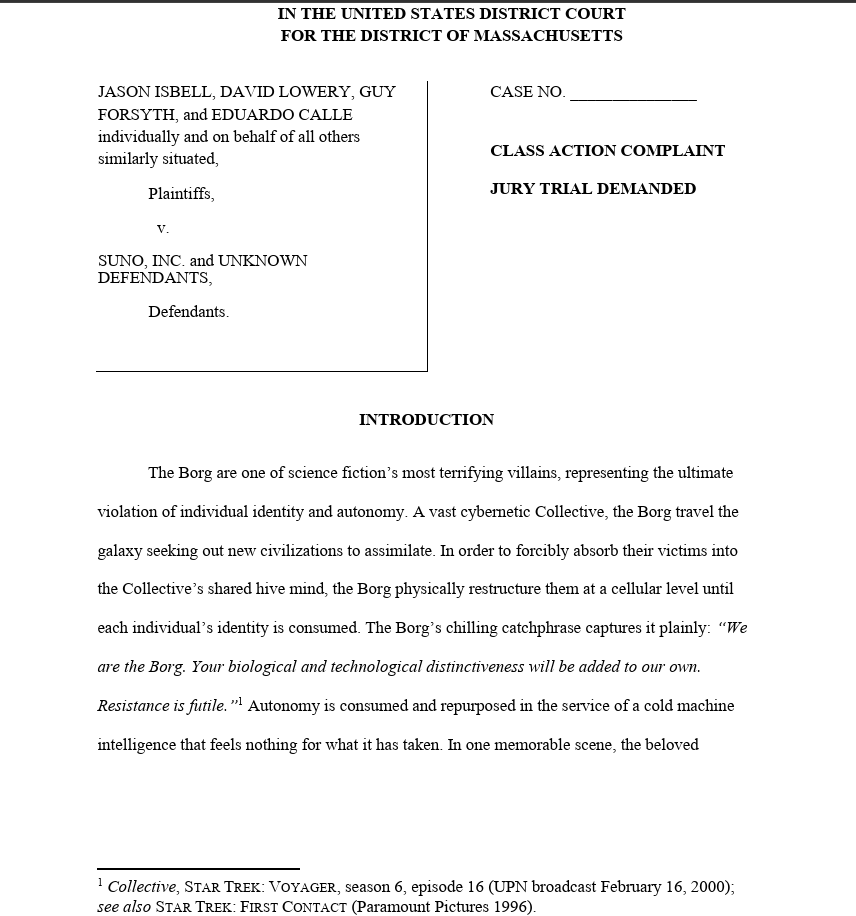
It is difficult to impress us here at JMSSS, but today, we have new legal writing heroes—a Boston and a Chicago firm teamed up to file an ‘identity theft’ lawsuit on behalf of a group of musicians against Suno, an online AI music creation machine that won’t let you use an artist’s real voice but will allow you to adopt their identity. (Yes, hi, let’s say I was born in Hibbing, Minnesota, oh, about eighty years ago, listened to a lot of Woody Guthrie, moved to 1960’s Greenwich Village and… you get the idea).
That’s the complaint above, it’s all about Star Trek: The Next Generation and the perfect metaphor: The Borg.
“You Will be Assimilated. Resistance is Futile.”
Click the image to read it in full.

Don’t Miss an Issue
Haven’t subscribed yet? Agree with Homer? Then don’t miss another issue, subscribe now. And . . . if you know someone who may enjoy this, please feel free to forward this issue to them.