
Shocked! Shocked!
For those not in the know: Raising Cane’s is a fast-food chain, founded in Baton Rouge, Louisiana, in 1996, that sells chicken fingers. It’s entire identity—menu, marketing, 2.5 million TikTok followers—is built around those chicken fingers (with a couple of sides). It recently moved into the Northeast opening in Boston in 2024. Not in a strip mall somewhere, but downtown Boston, a couple of blocks from the Common, on an upscale street closed off to traffic.
The opening was an event—former Celtics star Jrue Holiday and Red Sox legend David Ortiz were there for the ribbon cutting alongside the chain’s founder. More to the point, Raising Cane’s came in as a good neighbor. They spent a small fortune on air filters to keep the fried chicken finger smell from seeping into the offices and apartments far above the restaurant. About a week after the opening, the president of the Downtown Business Alliance, with an office directly next door, reported no odor complaints whatsoever. Next, a reporter walking through the building lobby couldn’t detect anything. At most, there was a faint waft of fried chicken on the sidewalk outside—that was the full extent of it.
When Raising Cane’s signed their lease, downtown Boston needed the help. Vacancy rates were up, foot traffic was soft, and restaurants and retailers were hardly lining up. Raising Cane’s took a chance—at $60,000/month rent—that their 2.5 million TikTok followers (the self-described “Caniacs”) would how up. They did.
By last summer, the market had shifted. Downtown rents came back up. Office vacancy eased. Raising Cane’s landlord announced that Panda Express was about to move in next door to Raising Cane’s. Not however that, along with apparently two million other food items, Panda Express sells “deboned chicken.” It’s in the lease that Raising Cane’s has exclusive rights to sell deboned chicken in the building. The landlord asked Raising Cane’s to waive the provision. Raising Cane’s said no. The landlord was faced with losing a $100,000/month lease. It was right about this time that the landlord suddenly noticed that Raising Cane’s smelled a lot like chicken fingers. What a weird coincidence!
They filed an eviction action invoking an “offensive odors” clause in the lease as grounds. As in, “we were stunned, stunned I say, to discover the chicken smell that now ‘permeated’ the building.” Raising Cane’s immediately spent more than $200,000 upgrading its exhaust system despite not really believing the claim. Both sides hired consultants. The consultants agreed the fix was sufficient. Boston Globe reporters took the elevators and walked the hallways sniffing away and talking to tenants. No one noticed a smell. Except the landlord.
A TikToker summarized the situation perfectly: “not your normal, average everyday stupid. This is advanced stupidity.”
The real problem isn’t the smell. It’s the lease, specifically, what it says, what it doesn’t say, and who gets to decide what an “offensive odor” means when the party invoking that clause also happens to be the one trying to bring in a competing chicken concept. Commercial leases are dense documents, and the clauses that seem most innocuous at signing—nuisance provisions, exclusive-use rights, termination triggers—are often the ones that generate the most litigation when business interests diverge.
Exclusive-use clauses are a good example. Raising Cane’s apparently negotiated the right to be the only deboned-chicken seller in the building. That clause is worth something. In this case, it’s worth refusing to waive even under landlord pressure. But a clause is only as valuable as the lease’s other provisions allow. An aggressive landlord with a separate termination trigger, however pretextual, can make a tenant’s life difficult enough to force a negotiation even when the tenant is clearly in the right.
What the Boylston Street dispute illustrates is the difference between having a right and being able to enforce it cost-free. Raising Cane’s may ultimately prevail. But it has already spent $200,000 on exhaust upgrades and is now spending considerably more on lawyers to defend a lease it already signed. That math changes every month the dispute continues.
The best contracts anticipate bad faith. They define ambiguous terms, terms like “offensive,” “nuisance,” and “reasonable,” with specificity. They include notice-and-cure provisions with teeth. They address what happens when a landlord’s business interests shift, as they inevitably do over the life of a long-term lease. A 2037 lease signed in 2023 will outlast the current building management, multiple market cycles, and quite possibly the fine-dining landscape that existed when the ink dried.
Raising Cane’s knew what it was—a chicken finger selling behemoth. The landlord knew who it was signing at a time when few large retailers of any type were flocking to downtown Boston. The contract, apparently, left too much room for interpretation. That’s a drafting problem.
Forget It, Jake, It’s Foxborough
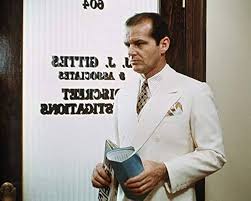
Foxborough Massachusetts is the home of Gillette Stadium (boo Patriots, go Jets). Fun fact as you read this:
Once upon a time—okay, from about the time of the Civil War to the 2000s—a spouse who suspected a spouse or business partner of two-timing, or gambling or alcoholism or [your favorite vice goes here) had two choices: try to follow them themselves or hire a private investigator. The PI, tec, sleuth, operative, gumshoe, Shamus, etc. occupied a very specific cultural role in non-criminal investigations. Sam Spade’s quest to find the Maltese Falcon started with an infidelity case. As did Jake Gittes’ trip to Chinatown. Elliott Gould’s Philip Marlowe in The Long Goodbye, shuffling through 1970s Los Angeles in a rumpled suit looking for a writer. Jim Rockford’s answering machine was filled with requests to run down insurance frauds.
Those were the days of a profession that existed in a world where the alternative to hiring them was simply not knowing. They charged by the day plus expenses. They had equipment. They had tradecraft. They got the photos.
Last summer, a Coldplay concert at Gillette Stadium produced one of the more memorable viral moments of 2025 (given the competition that is saying something). During Chris Martin’s “Jumbotron Song” (it does not take a genius to figure out that means it’s time to fire up the Coldplay Kiss Cam). That night it found Andy Byron, CEO of Astronomer, and Kristin Cabot, the company’s Chief People Officer, in what could most charitably be described as an extremely close conversation. When they realized they were on the screen in front of 66,000 people, they did what any two people with something to hide tend to do: they panicked and dove out of frame. Causing Chris Martin to quickly observe, “they’re either having an affair or they’re just very shy.”
It turns out that about 50 million views are that’s what happens when 66,000 people armed with smartphones catch a spontaneous event and share it across the social media universe.
Eight months later, just a few weeks after Mike Vrabel was named NFL Coach of the Year for guiding the Patriots (home field: Gillette Stadium) on an improbable Super Bowl run he was suddenly in the center of a not-so-very-different situation. Photos surfaced of Vrabel and Dianna Russini, a senior, highly regarded NFL reporter for The Athletic, at a luxury resort in Sedona, Arizona in a hot tub. On a private rooftop accessible only from one of the two-person bungalows that run $2,160 a night. Both are married to other people.
Aside the Gillette Stadium connection, here’s what the two situations share: no one needed a private investigator to uncover anything.
The Vrabel-Russini photos were taken by another couple staying at the same resort, who saw two recognizable people and had working smartphones. They sold the pictures to the New York Post for the cash equivalent of a few nights’ stay at the resort. They had already shared them on social media. Just a week or so after the Post published the Sedona photos, other Vrabel-Russini photos from as far back as 2020 began to surface, all from smart phones.
The repercussions were immediate. The Coldplay couple resigned from the company, they were breaking company rules that were supposed to be enforced by the HR director and CEO, i.e., them. Russini resigned under pressure from The Athletic. There is a longstanding, unflinching rule of journalism concerning sources: “Do not accept gifts, money, or favors, and avoid developing relationships that could be perceived as biased.” Given how much the Patriots love cheating, we can only assume Vrabel will be given a handsome bonus from his massage spa-loving team owner, Bob Kraft.
It should be noted that the couple who took the Sedona photos may soon have their own legal problems. The resort explicitly prohibits photographing other guests, and Arizona law has specific provisions around photographing people who have a reasonable expectation of privacy. But here’s the thing: that won’t make the photos disappear, doesn’t give Russini her job back, and doesn’t kill the Vrabel gossip.
There is a lesson here that has nothing to do with celebrities or tech executives or NFL coaches. It is simply this: the reasonable expectation of privacy in a semi-public space has been shattered time and time again.
This has direct consequences for anyone involved in litigation—or who might be. Discovery has always been the phase of a lawsuit where uncomfortable facts surface. What has changed is the volume, the speed, and the sources. Emails, text messages, social media posts, location data embedded in photographs, ring doorbell footage, and the casual snapshots of strangers have replaced the PI’s telephoto lens as the primary instruments of inconvenient truth. Courts have adapted. The rules of evidence have largely kept pace. The behavior of people who think they are unobserved has not.
The practical point is straightforward. If you are party to any civil or business dispute, the assumption that your private conduct stays private is no longer a reasonable one. What you do in public, semi-public, or in spaces that merely feel private ca surface in ways no one anticipated when the dispute began. Plan accordingly.
It Really Tied the Campus Together

Probate courts multi-task. They supervise the administration of estates. They resolve disputes among heirs. They interpret ambiguous documents. What they are not equipped to do—what no court is equipped to do—is read the mind of someone who is no longer alive. And yet this is precisely what a Suffolk County judge is being asked to do in one of the more tangled estate battles Boston has seen in years.
Rosalie K. Stahl was a Brooklyn-born heiress who spent most of her adult life managing a real estate fortune built by her late husband in postwar California. She was, by all accounts, a woman of considerable intelligence and attention to detail. She was also, by the end of her life, a resident of a memory care unit where she died in 2020 at the age of 100.
In 2004, Stahl purchased 73 Tremont Street, a 13-floor, 300,000-square-foot building across from Boston Common. She bought it for Suffolk University, whose downtown Boston campus had been widely scattered. Like the Big Lebowski’s rug, the building really tied the University together. Since 2004, the Rosalie K. Stahl Center has housed the president’s office, classrooms, the library, the health center, and the campus television studio. to use. Stahl’s name went up in bronze on the side of the building; Suffolk paid the expenses—rent mortgage, property taxes, and more—and operated the building as its own for 15 years. It was understood that the building would be Suffolk’s upon her death.
Then she died, and it wasn’t.
The estate’s trustee, Barry Brown, who had managed Rosalie’s business affairs since 1978, gave Suffolk a $17 million cash gift instead of the building, which is now valued at $125 million. Rosalie’s younger daughter, Jolie, argues that goes against everything her mother intended. Brown argues he carried out her wishes precisely. Rosalie’s older daughter, Robyn, sides with Brown. The two sisters no longer speak. Jolie despises Brown.
If this story were only this simple, it’d still be complicated and maybe a bit dry and boring. Thankfully, however, those are just the [very] basic facts, from there it makes a Thomas Pynchon novel seem uninventive.
The short version: Brown met the Stahl family when he went on a blind date with Robyn in 1966. Rosalie took a liking to him and after he graduated from Harvard Law, she put him in charge of her fortune. He began teaching at Suffolk Law School where he orchestrated the original 73 Tremont donation. Then he became Suffolk’s interim president. Then he left, to run Mount Ida College—an institution the Stahl estate subsequently loaned $23 million, nearly half of which was later forgiven. Shortly after, the school closed and its facilities were taken over by UMass.
The conflicts of interest have conflicts of interest.
But wait! It gets better. Brown, invoked the no-contest clause in her will (the one executed in the assisted living home in her nineties) arguing that Suffolk, by not simply pocketing the $17 million and going away quietly, is contesting the will and should get nothing at all. The professor/interim president who engineered the original gift, ran the university that received it, then departed to run a second college the estate quietly bankrolled to the tune of $23 million is now arguing that Suffolk’s reluctance to accept a fraction of what it was promised amounts to legal insubordination.
The judge’s response to all of this [so far] was to observe, on the record, that the court record had grown large enough to warrant “a moment of silence” for the trees that died producing it. Six law firms are now involved. There’s a pretrial hearing is scheduled for August, assuming a pending change of judges doesn’t push it further into the future, which it probably will. Why? Because, and we cannot make this up, one out of every four judges in the Commonwealth of Massachusetts is a Suffolk Law grad.

Don’t Miss an Issue
Haven’t subscribed yet? Agree with Homer? Then don’t miss another issue, subscribe now. And . . . if you know someone who may enjoy this, please feel free to forward this issue to them.