
Happy Not-Presidents’ Day!
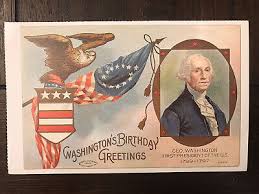
A third Monday in February lesson on ‘never-assume-what-the-law-is’:
Happy “It’s not Presidents’ Day.” Why? Because despite what Google Calendar and every mattress store and car dealership in the Northeast says, there’s no such holiday.
Really. See Section 6103(a) of Title 5 of the United States Code. ‘Presidents’ Day is the label Congress slapped on while making Washington’s birthday fit a three day weekend.
Washington’s birthday was a major holiday in the U.S. long before the Civil War though it wasn’t formalized as a Federal holiday until the 1880’s. And there it stood util an act of Congress in the late 1960’s muddled the waters – permanently.
That’s when the push to move holidays to the Monday schedule we now enjoy began. Congress, as always, had hearings. Somewhere along the line, Illinois representatives made the not illogical request that since Abraham Lincoln’s birthday was so close to Washington’s they should be celebrated together. At the time, Lincoln’s birthday was strictly a state by state holiday—we’ll leave it to you to figure out what the split may have been.
Since this new holiday, giving us all a three day weekend in the middle of February, would celebrate the two prominent former presidents it was naturally enough labeled ‘President’s Day’.
Who would argue with a day devoted to Washington and Lincoln? Well, Virginia in the mid-1960s for one. The late unpleasantness between the States was only a hundred years old and Virginia didn’t like the idea of the usurper from Illinois sharing the spotlight with its most revered son. Virginia blocked the proposed bill in the House of Representatives in the discussion stage. It never passed. It was never taken up again.
The third Monday of February was designated Washington’s Birthday, Lincoln’s Birthday remained as it is still today—a state by state optional holiday. It has never been a Federal holiday.
So, Presidents’ Day isn’t Presidents’ Day, it’s really President’s Day—as in one particular President. Interestingly, Presidents since the 1968 Act passed don’t seem to be in much of a hurry to correct the possessive marker.
Moral of the story: never assume you know what a law says without checking . . . and, please, don’t use AI, it’s still in the habit of making stuff up.
Monty Python’s Last Shows
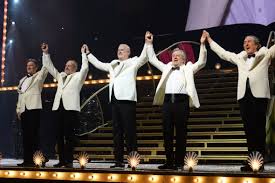
About a month ago, TCM ran a night of Monty Python films and documentaries. Sometime around 2:00 am, they ran an excellent documentary about the last live show Monty Python performed.
In 2014 the surviving members of Monty Python reunited for a series of ten shows at London’s O2 Arena. Word spread quickly. all ten shows sold out almost immediately,. The O2 Arena holds 20,000.
The show was called Monty Python Live (Mostly) – One Down, Five to Go. Each of the members was well into his seventies, at least one was openly dealing with the first signs of dementia. They hadn’t been together in years, there were some grudges, some underlining tensions, a lot of forgotten lines, some arguments about credit for skits, and a whole lot more but in the end they came together and put on a great show and an even better documentary about the creative process.
None of it would have been possible if it weren’t for a business decision made in 1973.
That’s when Monty Python came up with the idea for The Holy Grail. Great idea but no one wanted to fund it. No one. Terry Gilliam recruited an old roommate, Mark Forstater, to help raise funds. The six members of Monty Python agreed to share the proceeds of The Holy Grail equally with Forstater.
Together with George Harrison, they managed to raise just enough to start filming—lack of funds is the reason there are no horses in The Holy Grail, only coconuts. It’s also the reason it ends where it does despite a spectacular final battle scene all mapped out.
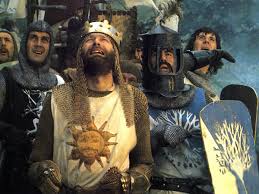
The Holy Grail bombed at the box office. It was a dud. Despite its incredibly low budget, it did not turn a profit and almost everyone involved in it lost money one way or another. Over time it achieved cult status – but movies playing at midnight at discount prices don’t exactly achieve Titanic status at the box office.
In 2005, Eric Idle was instrumental in bringing The Holy Grail to Broadway as Spamalot. The musical version of the movie with lots of other Python bits tossed in (spam, for instance), along with some entirely new bits was an enormous hit. Its first run on Broadway lasted four years, it played in London’s west End for over three. At any given time, it is touring the U.S..
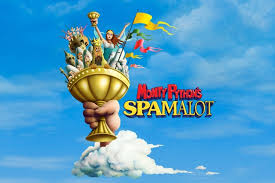
Needless to say, it was and is hugely profitable. Enter Mark Forstater. He claimed that under the terms of his original 1973 Holy Grail producer’s contract he was owed one-seventh of the total proceeds of Spamalot, worldwide. The crux of the claim was that Idle was using the same songs and plot as the movie.
Apparently, the contract had not specified . . . well, much of anything. It certainly didn’t break down responsibilities or intellectual property ownership. Mark, while calling himself (for decades) the seventh Python, was only responsible for raising capital. (What Eric Idle and the others call him to this day is not fit for a family newsletter here or in the UK).
Mark sued. The Pythons offered him one-fourteenth of the profits. He refused. It went to trial and then to an appellate court. When it finally ended the ‘real’ members of Monty Python owed over $1.4 million in attorney fees and royalties.
Monty Python Live (Mostly) – One Down, Five to Go was organized and performed to pay the court judgment.
Poor planning and poor drafting had severe implications over thirty years down the road.
Who Lost the Most When the Eagles Won?
This guy:
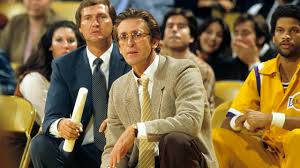
That’s former NBA player, coach, Hall of Famer, and current president of the Miami Heat, Pat Riley. Pictured here in 1989 as he was guiding the Lakers to what everyone assumed would be their third straight NBA championship.
You would think that aside some minor interest in the game itself, Riley was a bit too occupied with the Jimmy Butler fiasco/trade to really care who won the Super Bowl. Normally, sure. This year, however, could have seen the Chiefs winning their third straight championship. The NFL’s Super Bowl era’s first Three-Peat and for Riley that meant hundreds of thousands. Of dollars.
Back in 1989, Riley and his team were besieged by questions about their chances of becoming the first team since the1965-66 Celtics to win [at least] three in row (they won eight in a row). Laker’s starting shooting guard and the team’s third leading scorer, Bryon Scott, is credited as the first to coin the term: ‘three-peat’. though HBO’s Winning Time claims it was Wes Mathews (who was not with the team for the 1988-89 season).
‘Threepeat’ became a mantra for the Lakers as they swept toward the 1989 Finals. It led every media discussion of the NBA season. So much so that Pat Riley hired a lawyer and trademarked it.
That’s right, Pat Riley owns Three-Peat. It didn’t work out for him in 1989. The Lakers swept to the Finals but lost Scott and Magic Johnson to injuries on the way and lost to the Pistons. But Michael Jordan’s Bulls, the 1998-2000 Yankees, and 2000-2002 Lakers were just around the corner.
Riley owns six trademarks for various forms of “Three-Peat,” giving him rights to the use of the phrase on everything from apparel to jewelry to his latest two filings — backpacks and beverages.
For every t-shirt, hat, jersey, patch—anything sold with ‘Threepeat’ on it, Riley got an undisclosed percentage – he will only acknowledge that it’s “a lot.”
The week before the Super Bowl it was announced that Riley had reached an agreement with the Chiefs, Chiefs, Fanatics, New Era, Wilson, Riddell and Wincraft that would allow them to use three-peat on their merchandise.
But it was not to be and now ‘three-peat’ is starting from scratch in the MLB, and NFL. It’s on the shelf in the NBA and NHL unless the Celtics and Panthers repeat in June.
S.S. United States Update

She moved! On Friday afternoon, the S.S. United States moved for the first time in over thirty years. She was pushed across her berth to ready her for the trip to Mobile, Alabama scheduled for today. In fact, if you happen to be reading this because you’re gridlocked somewhere near the Delaware River, it’s because the Walt Whitman, Commodore Barry, and the Delaware Memorial Bridges will be closed while she passes under. The first two because the United States is so big even at low tide she barely clears them, the third because of fear of spectators discovering a whole new form of distracted driving.
If you’re stuck in that traffic jam then you’ll know that years of lawsuits, court orders, fines, penalties, whacky and not-so-whacky plans, and ‘last minute’ pleas to every level of state and federal government (the last to the White House last Monday) are finally over.
Austin Powers in Goldmember . . .
. . . nailing IP law
From a Business Disagreement to a Civil RICO Case

Every so often, we run across the Holy Grail of business disputes. One case with a dozen different issues that encapsulates the entire spectrum of business law challenges, offering lessons in corporate governance, partnership disputes, and crisis management.
A case with many forks in the road to a ‘global solution,’ each one missed for a variety of reasons, eventually went nuclear. Years later, a former owner filed a civil RICO action.
Just over ten years ago, Compass Coffee was that quintessential feel-good story of American entrepreneurship. Two former Marines, Michael Haft and Harrison Suarez, bonded over their shared love of coffee while serving in Afghanistan.
When they returned home, they self-published a guide to brewing the perfect cup. It went viral. They took the next logical step and created Compass Coffee in 2013. Their vision was simple: create a local, high-quality coffee brand that stood out in Washington, D.C.’s competitive market.
“With grit, camaraderie, and a focus on community,” they built Compass Coffee from a single shop into a thriving local chain, complete with a massive roastery and a reputation as a veteran-owned success story. Their coffee was served at the White House and featured at prominent political events.
But beneath the surface—like the ear in the beginning of Blue Velvet (RIP David Lynch) hidden tensions were brewing that would eventually unravel this feel-good narrative, turning it into a cautionary tale of miscommunication, broken trust, and legal battles.
The Compass Coffee lawsuits that followed involved allegations of pandemic relief fund misuse, breach of fiduciary duty, breach of contract(s); fraud, and so much more. A legal storm that hit nearly every facet of business operation, governance, and law.
The case is more than a dispute between two founders. It’s a cautionary tale of what happens when corporate governance is neglected, when bylaws and agreements are insufficient or ignored, and when communication breaks down at the highest levels.
Now that the nuclear option has been employed and every detail is well on its way to becoming very public, we’ll be writing about the many, many issues over the next weeks. Blogs, newsletter articles, and soon, on our Substack account—we’ll be following and commenting.
Above all, the Compass Coffee saga is a reminder that clear communication and proper documentation are non-negotiable in any business. When founders or leaders bypass these essentials, disputes quickly escalate into full-blown legal battles.
At its heart, the Compass Coffee lawsuit is about what happens when governance fails, when agreements are poorly crafted or ignored, and when leadership doesn’t uphold its fiduciary duties. These are challenges that any business, large or small, could face without the proper structures and safeguards in place.
Over the coming weeks, we’ll unpack these issues in greater detail, using the Compass Coffee case as a lens to explore best practices in corporate governance, partnership agreements, compliance, and more. Whether you’re a founder, shareholder, or executive, there’s something in this story for everyone.
Stay tuned as we turn the chaos of Compass Coffee into actionable insights to help you safeguard your own business.

Don’t Miss an Issue
Haven’t subscribed yet? Agree with Homer? Then don’t miss another issue, subscribe now. And . . . if you know someone who may enjoy this, please feel free to forward this issue to them.