
Wasting [assets] Away In Margaritaville

The Wild Bunch is an iconic ’60s film, a Western film made when Westerns were fading into irrelevance, bringing a modern sensibility to the genre. It’s bloody, sarcastic, and memorable.
Early in the film, William Holden, Ernest Borgnine, and their gang rob a railroad office in a dusty Texas border town in the early 1900s. Mayhem follows—a beautifully choreographed shootout that’s been copied hundreds of times since. The gang escapes with heavy bags they believe hold enough cash to retire. In a way, The Wild Bunch is also an iconic ‘one last job’ heist film.
When they finally ditch their pursuers and open the bags, they’re filled with thousands of worthless steel washers. They’ve been set up; they had ridden into a trap designed to catch them. They have nothing. Holden assures his crew he’ll come up with another plan – he always has another plan – and walks in to the desert. He returns hours later with the solution: they’ll start running guns to Mexico—selling to bandits, Pancho Villa, Zapata, or whoever will pay.
Immediately, the gang’s Mexican member, Angel, says, “You expect me to help you sell guns to the men who razed my village and killed my family?”
Holden, after the briefest of pauses, “Angel, ten thousand dollars cuts a lot of family ties.”
No truer words . . . so, about a billion-dollar empire built on cheeseburgers, margaritas, island escapism, clothing, 17 gold and platinum albums, and decades of sold out arena shows:
When Jimmy Buffett died in 2023 he left a newly written will and a marital trust funded with $275 million in assets behind. Testimony that as his fortune and fame grew, he employed the best lawyers and advisors to protect the fortune and his family for generations.
Except, it is already unraveling. All that meticulous planning and carefully structured trusts are now caught up in very public disputes while headed to courts in two very different jurisdictions.
This is where things could get really complicated and we could get lost in the many arcane technicalities of estate and trust administration . . . but we won’t because the underlying issue is singular and simple – communication. For whatever reason(s) Buffet named his wife, Jane, and his longtime accountant/business manager/financial advisor, Richard Mozenter, as co-executors. Jane is also the sole beneficiary until her death when the Buffet’s children replace her. There is no tie-breaker, just Jane and Richard. Which is a shame because these two people not only don’t get along they appear to be speaking two different languages.
Court filings reveal a frayed relationship deteriorating into accusations of sabotage, secrecy, and betrayal. Jane has accused Mozenter of withholding crucial financial information, ignoring her wishes as sole beneficiary, and generally disregarding his fiduciary duties. Mozenter has reportedly told Jane to tap into her own personal estate to fund expenses—expenses which, legally, should come from the trust Buffett set up explicitly to provide for her.
Mozenter claims he’s simply protecting the estate, preserving Buffett’s legacy according to his professional judgment. Jane sees it differently: a longtime trusted advisor deliberately cutting her off, turning a blind eye to her needs and wishes—exactly what Buffett tried to avoid with his careful planning. Mozenter’s $1.7 million yearly fee hangs heavy over the whole mess.
The irony is thick: Buffett’s decades of smart estate planning, protecting wealth and legacy, is unraveling not because of a bad investment or a legal loophole—but simply because the two people he trusted most to carry out his wishes apparently despise one another.
All the money, trusts, lawyers, and well-crafted documents mean as much as a bag of worthless steel washers if the people in charge refuse to communicate.
“Ladies . . .”
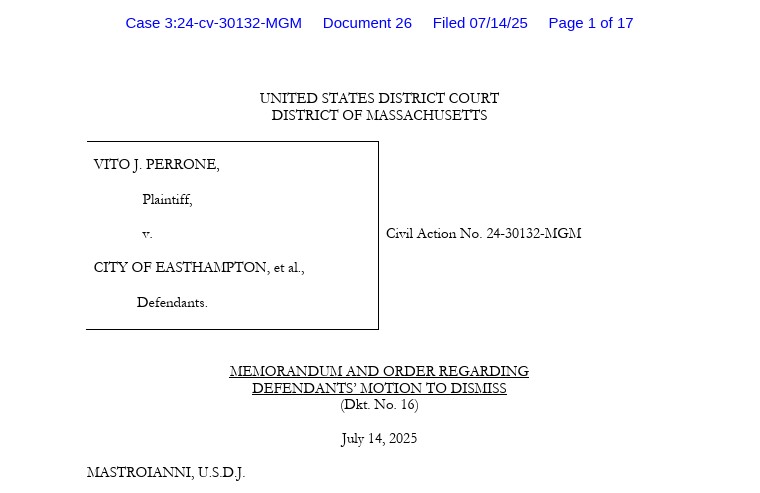
It was enough to send The Daily Mail and dozens of its ilk into a frenzy:
Super Woke School Committee Fires Superintendent Over Email Greeting ‘Ladies’
The tone, if anything, got worse in the body of the story as, across the media landscape, the story of a school administrator, Vito J. Perrone, losing his dream job to head the Easthampton (Massachusetts) school district because he addressed an email to his soon-to-be bosses on the school committee as “Ladies” spread across social media. Outrage, online fury, the predictable debates over “microaggressions” and politically correct speech.
Perrone sued in federal district court. Last week Perrone lost in federal district court and ‘Ladies’ had little to do with court’s dismissal of the case before trial.
Here’s what happened: Perrone interviewed with the committee – all women – in March 2023 in the late afternoon. That evening, a committee member called him and said that after a 4-3 vote he was going to be offered the $151,000/yr superintendent’s position at the terms agreed upon during his interview, contract to follow.
The terms for that contract were approved, 9-0, a few days later and promptly emailed to him with the contract attached.
That’s when Perrone sent the email in controversy. He did indeed start with the salutation ‘Ladies.’ Had, “I accept your offer, this is my dream job, thank you for your trust in me’ or anything else followed it’s probable – but not certain – a committee made up of graduates of Amherst, Mount Holyoake, and Smith College would have overlooked the, ah, faux pas.
But he did not. Here’s the rest of that email:
Good evening! I perused the contract and have three requests:
1. Bullet 3 (compensation): I was told that the $151,000 initial salary was nonnegotiable, and I understand the rationale behind the decision, so I request that the last sentence of the bullet read as follows: The annual salary for fiscal years 2025 and 2026 shall be negotiated, but shall not be less than a cost of living adjustment (COLA) of 3% and 3% respectively for the final two years of the contract.
2. Bullet 12 (Annual Vacation Days): Instead of 26 vacation days, I request 30 vacation days effective July 1 of each contract year with all other contract language remaining the same.
3. Bullet 13 (Sick days): I worked for six years in the EPS and accrued a reasonable number of days in sick time. I request 40 sick days effective July 1 of the FIRST year of my contract and 18 days effective July 1 of each contract year thereafter with all other contract language remaining the same.
Perrone obviously did not hire an attorney to assist with his contract even though he was dealing with a contract that was subject to stringent municipal and state regulations.
He obviously had never even seen The Paper Chase or A Night at the Opera – had he, he would have known the second he hit send he had just made a counter offer and until that counter offer was accepted he had no contract.
The head of the school committee was, however, a practicing attorney. She immediately flagged it and told the other members of the committee that if they had any doubts about Perrone (there were some other ‘unsettling’ things about his attitude after the first interview) they should withdraw the offer now while there was no contract rather than wait for something to happen and they were forced to fire him “which would be hard.”
The Truth Behind ‘Student Athlete’
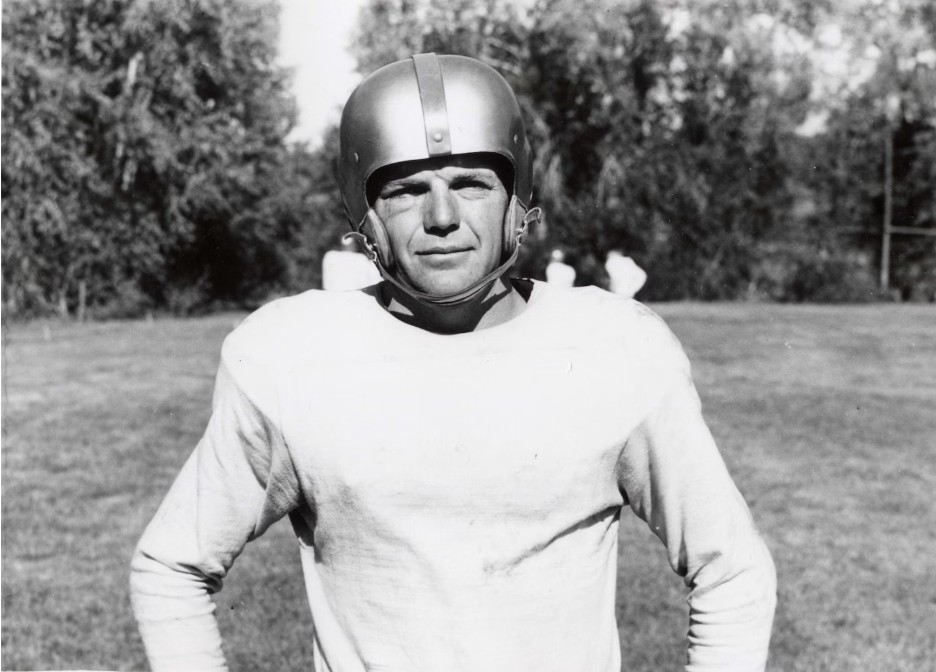
On July 1st the college sports landscape, already roiled by NIL payments and the transfer portal changed forever when a federal court allowed schools to share revenue with their athletes. A ‘salary cap’ of $20 million per school for college athletes is now in effect.
How did we get here? Well, it started with a lawsuit and the invention of ‘student athlete.’
The history:
The first college football game was played on November 6,1869 between Princeton and Rutgers – though it more closely resembled a combination of soccer and rugby. The first official college football rules were adopted on November 23, 1876, in Springfield, Mass., by representatives from Columbia, Harvard, Princeton and Yale – though the game now more closely resembled rugby.
By the turn of the century, the future of the sport was in serious peril. Mass formations and gang tackling made it brutal. During the 1904 season alone, there were 18 deaths and 159 serious injuries on the field. Colleges hired ringers not enrolled in school. Some schools banned the sport. There was a public outcry for football to either be reformed or outright abolished.
In October 1905, President Theodore Roosevelt, a longtime football fan (of course), called together athletics leaders from some of the top football schools — Harvard, Princeton and Yale — and urged them to clean up the game even as football deaths and injuries continued to mount. New York University Chancellor Henry M. MacCracken convened a meeting of 13 schools in December to form the Intercollegiate Athletic Association of the United States – the name was changed to the National Collegiate Athletic Association in 1910.
Over its first fifty years, the NCAA oversaw sports and eligibility – to a point. Membership was purely voluntary and schools came and went on a whim. It had no investigatory or enforcement powers. Abuses of ‘the amateur’ rules were rife, especially at football schools were alumni and boosters were well known to pay players’ tuition and room and board. Players ‘transferred’ schools constantly. The term ‘student athlete’ did not exist and if it had it would have received universal ridicule. We’re talking about a system that the Marx brothers barely had to stretch to lampoon in Animal Feathers.
It all changed in 1955 – not to bring order to a chaotic environment but to defend against a lawsuit.
In the Fall of 1955, Ray Dennison, a U.S. Army veteran, husband and father of three who came back to join the Fort Lewis A&M football team at the encouragement of the head coach, went to make a tackle when an opponent’s knee fractured his skull. He died 30 hours later.
Dennison’s widow filed a workers’ compensation claim, arguing that her husband had effectively been an employee of the school, considering he was performing work (playing football) for the university’s benefit when the tragic accident occurred.
The NCAA, sensing a potentially costly precedent (and an opportunity) quickly responded. Walter Byers, the executive director, knew they had to avoid the perception that athletes were employees at all costs. If athletes could claim employee status, schools would be liable for workers’ comp, benefits, and potentially even wages.
Thus, Byers invented the term “student-athlete.” It was a carefully calculated phrase intended to emphasize that athletes were, first and foremost, students merely participating in extracurricular activities. Fort Lewis A&M and the NCAA eventually won the suit.
In repeatedly using the term in media, marketing, and communications, over the following years, the NCAA successfully positioned athletes as amateurs, effectively insulating schools from all legal claims and financial liabilities. Within a decade the NCAA’s grip on collegiate sports nationwide had become all-encompassing and increasingly draconian.
Until 2017, the term allowed colleges and universities to profit enormously from athletics—generating billions through broadcasting rights, ticket sales, and merchandise—without compensating the athletes who actually created this wealth. Players risked injury and dedicated countless hours to sports while institutions profited, coaching salaries soared, schools sold their stars’ jerseys and pocketed the money while also ‘licensing’ those same stars’ images to video games, trading cards, and much more.
There was never anything noble about the term “student-athlete” – it was just a made up term of art to, first, avoid paying a workers comp claim and later to control college athletes and their schools while avoiding paying pretty much anything to athletes. It was the justification for things that were, until 2017, accepted on their face while administrators and coaches shook their heads and started sentences with, “We know it’s not fair, but it’s the rules and…”
“Student athlete” is the reason Ray Allen went hungry at UConn when he had practice but the campus and it’s food halls were closed – the NCAA approved per diem allowance for ‘vacation’ food was pitiful. Allen, in an interview with the New York Times just before he was the number 5 overall pick in the NBA draft, said he once calculated that didn’t eat and saved his per diem for a full week he would have been able to – barely – buy one of his jerseys sold in the UConn bookstore. The punchline here is that Allen would have had to buy his jersey, NCAA regulations in the 1990s banned colleges from gifting players their own jerseys.
Cartman on ‘Student Ath-a-letes’
Strategic Planning
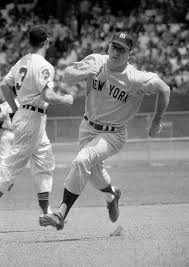
We do a lot of planning, a lot of strategizing. We’re good at it. Very good. We strive to be as good as Mickey Mantle . . . because this was masterful.
Sometime in the late ‘50s, the Yankees brought up a nineteen-year-old shortstop. The Yankees had won 7 pennants and 6 World Series in 8 years. The kid, however, was hardly cowered by all that, he was cocky and irritating.
His chief target was, incredibly enough, Mickey Mantle. Mantle had come up as a 19 year-old shortstop in 1950 renowned for his power and speed. Mantle was timed at 3.1 seconds to first base, the fastest ever recorded. The rookie claimed he was faster and started nagging him to race.
By the mid-’50’s Mantle was still fast but had suffered a series of leg injuries, the most infamous one in the 1951 World Series. He didn’t want to race but, like an aging gunfighter in the Old West, he felt he had to accept the challenge.
After weeks of listening to the rookie’s claims, Mantle finally walked up to him in Kansas City and said they’d race. It was 100 degrees out. Mantle strode out to home plate under a blazing sun followed by most of the entire Yankee roster. Bets began to fly.
The rookie jogged to the plate and said, “Okay, let’s go.”
Mantle shook his head, “Not so fast, I how do I know you’re fast? I only have your word for it. I don’t want to waste my time…”
The kid was flummoxed. Mantle went on, “First, you have to beat Bauer.” Hank Bauer was the Yankee’s 33-year-old right fielder and Marine veteran of Okinawa – he looked forty on a good day. The kid readily agreed. What he didn’t know was that Bauer was still one of the quickest Yankees. The kid won, but had to bust it over the last yards.
Slightly winded he reported back to plate where Mantle was waiting with pitcher Don Larson (of World Series perfect game fame). “Gee kid,” Mantle said, “you beat an old man – guy was wounded in the war for Christsakes, that didn’t tell me anything – you want to race me, you gotta beat Don here, you know, someone closer to our age.”
The rookie agreed (he had no choice with the rest of the Yankees watching and hollering), completely unaware that Larson, a great athlete, was the second fastest guy on the team. The kid beat him by a few feet.
Sweating, breathing heavily, he went back where Mantle was waiting with Yogi Berra. “Wow, you beat a pitcher, big deal,” Mantle said, “beat Yogi and we’re next.”
The kid looked at Yogi – stocky, short-legged, and a catcher – lit up, “sure, let’s go.”
The kid hadn’t been in the Majors long enough, in the era before televised games every day, to know that Berra was one of the quickest players in baseball. Running to first (and all the bases, come to think of it) is all about quickness. The kid beat him by a whisker.
Drenched in sweat and panting he walked back to the plate to find a fresh Mantle in a crouch, “Nice job, ready …one, two, three go,” and he blew him away. The kid was barely able to finish in the heat.
Always plan ahead.

Don’t Miss an Issue
Haven’t subscribed yet? Agree with Homer? Then don’t miss another issue, subscribe now. And . . . if you know someone who may enjoy this, please feel free to forward this issue to them.