
About Valuations…
. . . timing matters
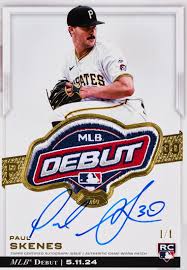
Pirates pitcher and 2024 National League Rookie of the Year, Paul Skenes’ 1-of-1 Rookie Debut Patch Autograph baseball card sold for $1.11 million at auction via Fanatics Collect last Friday. It’s one of the highest prices paid for a baseball card. The winning bidder was Dick’s Sporting Goods, the card was found by an 11-year old in Los Angeles when he opened a stocking stuffer gift pack.
The kid, unnamed, turned down an initial offer from the Pirates – no cash but a 30-year pass to all Pirate games along with other perks. Cynics would note the Pirates record over the years and wonder if an enticing second offer would have been 15-years.
Cynicism aside, the kid made a great deal, striking while the ‘asset’ was hot. After all, while Skenes is scary good, he has also appeared in exactly 23 games so far in his career. Is he the next Justin Verlander or Clayton Kershaw? Or is he the next Mark Fidrych?
In the late 1980’s through the mid-1990’s baseball cards were hot. They were the cool investment option, a generation of middle aged men blamed their mothers for tossing their collections when they shipped off to college. Monthly guides to the ever changing value of cards were published, tag sales were ransacked.
For the most part, it was all hype, except for a few notable exceptions like the famous Mickey Mantle Rookie Card, baseball cards were never that valuable because they were never that rare.
The problem, though, from a ‘we’re trying to settle a business dispute in the real world’ perspective was that a lot of people never got that message ~ they still think most baseball cards have real value. Their expectations didn’t match the reality of present day valuation.
Not too long ago, Mental Floss published an article called 22 Things You Owned in the ‘90s That Are Worth a Fortune Today. It’s fun and worth the read, especially if you were a kid – or had a kid – in the ’90’s.
A close reading of the piece, though, told a very different story. Qualifiers were everywhere – for those who chose to notice. ‘Still in Box’, ‘Sealed’, ‘Complete Set, ‘Mint Condition’, “Working Condition’, and more are noted on every listing.
Those mark the differences between collector value and tag sale value. This is a crucial distinction that is usually lost when someone has high expectations.
Timing, of course, is always an issue. Right now, today, Dick’s Sporting Goods has set the market price for the Skenes card. They won the auction so it’s safe to assume that there were others willing to almost pay that amount. So, is $1.11 million a solid valuation? Sure – today.
If Skenes, as many are projecting, wins the Cy Young this year, it’s probably worth a lot more. If Skenes unfortunately goes the way of a Pirate star pitcher of the past, Steve Blass (19-game winner in 1972 and star of the World Series, he showed up at Spring Training in 1973 a favorite for the Cy Young only to discover he suddenly could not throw a strike) it’s probably worth a, well, 1972 Steve Blass card now valued at between $1.95 (worn) and $175 (mint).
An injury, Steve Blass Disease (coined in 1973), the league catching up with him, a dozen other ‘non-Hall-of-Fame-track’ occurrences over his career and the card is more of a curiosity than an asset. The current owners, doubtlessly, will feel differently.
How to Turn a Contract Dispute Into a Federal Case
“Netflix, you’re greenlit …” with that South Park nailed the streaming frenzy of 2018 where Netflix and the rest were desperately searching for the show that would take over for Game of Thrones.
In 2018, streaming services were looking for new properties everywhere. In less than a decade, the number of scripted TV shows had soared from 200 to more than 500. Finding the next big draw was a priority and the streaming services went after it all out, Netflix gaining some notoriety by seemingly throwing money everywhere with little to no regard for, well, money. Very little, if any, vetting was ever done.
That’s how it came to be that a young director with a few award-winning commercials under his belt and a famous box-office bomb as his only feature (Ronin 47) went to Amazon with the idea for a sci-fi series about ‘human robots.’ He was offered an “informal eight-figure agreement.”
Word quickly got around the industry and before HBO could put it in writing, Netflix “swooped in” with an enormous offer. He signed. Netflix gave him carte blanche to ‘get it done.’ ‘It’ was ill defined. When was even murkier.
They gave him $55 million over the next three years. In return, Netflix got a few unrelated scenes filmed in exotic (read: expensive] locations. There is no show.
The lawsuits started flying. The bottom line until late last year: Netflix had absolutely no oversight over the project whatsoever. No real reporting requirements, no management structure keeping tabs. No effort to enforce some kind of accountability. They basically handed an untried director with no production background and a ‘we’ll’-make-’the-’story’-up-as-we-go’ idea $55 million.
In business law we refer to this as insane.
The filmmaker, Carl Erik Rinsch, could account for $44 million spent on the project. He could not account for the remaining $11 million. Netflix sued – although they were willing to settle for at least a few of the episodes they had paid for. Not only did Rinsch not settle with Netflix, he countersued claiming that Netflix owed him money.
As discovery began, it became evident that the $11 million was sitting in cryptocurrency “and millions of dollars worth of high-end furniture and antiques and hundreds of thousands in watches and high-end clothing, along with five Rolls-Royces and a Ferrari.”
Sometime last year Netflix turned everything over to the FBI’s New York Field Office. Last week, the Acting U.S. Attorney of the Southern District of New York indicted Rinsch on charges of wire fraud, money laundering and unlawful monetary transactions.
He posted a $100,000 bond while undoubtedly wishing he had worked it out with Netflix as soon as it became evident the series was never going to be completed.
Contracts and Einstein

Einstein Was No Einstein When it Came to Contract Law
There’s a story about Albert Einstein that has floated around for decades, recently boosted by YouTube. It goes like this:
Einstein is on a long flight with a fellow scientist. Somewhere over the ocean (it’s a different ocean in every telling) Einstein, bored, proposes a deal [read contract]. “I’ll give you five hundred if you ask me a question that I don’t know the answer to . . .and you give me five bucks for every one of my questions you can’t answer.”
“Sure, good deal, shoot,” the scientist answers.
“What is the exact distance between Earth and the moon? Exact.”
“Beats me,” he answers and hands over five dollars, “my turn, what goes up a hill with four legs and comes down with three?”
Einstein is nonplussed. After a long pause he pulls his wallet out and hands over $500.
After the scientist gleefully pockets the cash, Einstein asks, “So, what does go up a hill with four legs and come down with 3?”
The scientist smiles, pulls out five bucks and hands it to him.
Einstein [not a lawyer] inadvertently created a Grand Canyon sized loophole and his scientist friend was only too happy to take advantage of it. Moral of the story: if the smartest [not a lawyer] man in the world can’t execute a simple contract . . .
Fat Fingers

A couple of weeks ago John Oliver covered sports betting – you can watch it here.
It’s probably obvious that gambling in sports is big business—in-person, online, and billions are bet every month. As I write this I have the MLB Network on in the background showing highlights of last night’s games – there’s a Fan Duels logo taking up the entire lower third of the screen and later they’ll be segments going over the day’s ‘best bets.’
Sports books still employ humans to set some odds, but now more reliant than ever on algorithms and programs operating in real time during games to set odds.
Mistakes are made. They are not infrequent. In 2022, a major sports book, using a ‘human operator’, set the over-under of an NFL game at 500. For the non-NFL, non-gamblers among us, that means that you could place a bet that the combined points of the teams playing would be less than 500.
The most combined points ever scored in an NFL game is 116. Five hundred is insane; it could never happen.
But people took the bet. Knowing it wasn’t possible to come close. Knowing they took the surest thing in the history of sports betting.
In short, they knew it was a mistake. The sports book did not honor the bets; they pointed to a clause in their contract that allowed for voiding a bet because of a ‘fat-finger error.’
‘Fat-finger error’ might be the best, most perfectly descriptive phrase ever—it means that someone typed in the wrong numbers. The true over-under was 50. Obviously.
People threatened to sue, but, come on.
The ‘fat-finger error’ is in every sport’s betting contract—somewhere. And it makes sense for everybody. Simple; nothing to see here; no grounds to sue and demand payment.
There is a problem, however: “Too many sportsbooks are using the “obvious error” rule as a “get out of jail free” card, letting them clean up on props and parlays against casual bettors while voiding big winners “repeatedly, indefinitely,” instead of being required to take down flawed products and address their weaknesses.”
That was Ed Miller, a former odds’ maker, quoted in the Washington Post, in a story about Christopher Kozak, a derivatives trader and experienced sports gambler. “Last November, on a trip to Nashville, he placed 10 NHL same-game parlays through Hard Rock’s sportsbook and won three of them. In one $300 wager, he bet that eight players wouldn’t score in a game between the Anaheim Ducks and Florida Panthers, and that Anaheim would score fewer than three goals.”
He won $127,420. . . Except Hard Rock refused to pay it. The sportsbook notified him several days after the games that his payouts were an “obvious error” and he wasn’t owed anything beyond a refund.
When Kozak unsurprisingly pushed back, Hard Rock tried to renegotiate the odds—a week after the games were played. The company refused to explain the nature of the “error” or what made it “obvious.”
This, of course, is very different from our ‘cases’ above. There’s a clear breach of contract, and there is certainly very real damage.
Kozak, by the way, doesn’t have to go to court; after the Washington Post started asking Hard Rock for its records, it paid the winnings in full.
Obviously (we hope) if you don’t have a major newspaper helping out when this happens to you, you need an experienced attorney.
Don’t Miss an Issue
Haven’t subscribed yet? Agree with Homer? Then don’t miss another issue, subscribe now. And . . . if you know someone who may enjoy this, please feel free to forward this issue to them.