
Happy Thanksgiving!

We can debate—perhaps endlessly—the best Christmas movies of all time but there’s no debate that the greatest Thanksgiving movie is Planes, Trains, and Automobiles. It’s probably John Hughes’ best film, and one of the top ten holiday movies of any kind.
It’s worth watching at least once a year, preferably in the few days leading up to Thanksgiving. You’ll not only laugh every time (oh, the Edie McClurg car rental scene!), but also find something new every time.
Like many habitual viewers of the “trials” and tribulations of Del and Neal, we have also noticed a few incongruous shots, bits of dialogue that seem to come out of the blue, unexplained things like the black eye Del sports one morning, and why was their room robbed? (Yes, there was a reason).
Most of all, though—and I know I share this with even the most casual PTA fan, there’s the matter of Neal’s wife, Susan.
What’s up with Susan? Neal’s plane is rerouted to Wichita due to a snowstorm she can clearly see outside her window yet when Neal calls, late, she’s… hardly warm. She’s questioning, at best. It gets worse with every call Neal makes. She is unhappy, perhaps sarcastic, certainly not accepting of any of Neal’s tales of broken trains and bus rides from hell. Most of all she almost—not quite—openly mocks him whenever he mentions Del.
Laila Robins, the actor who played Susan, has played real badass women in Homeland and The Boys, but she still gets questions about her stilted approach to Susan. As in, “Why were you so mean to Steve Martin?”
Those questions finally came to an end—surely to her relief—in 2022 with the release of the original script for PTA. Fans have known for a while that PTA was originally three hours long but the studio, fearful that no one would sit through a three-hour comedy, made Hughes cut it in half. That it works so amazingly well is a credit to Hughes and his editors, but to the discredit of Susan.
Here’s what was supposed to happen, all filmed and dropped to the cutting room floor: Neal takes the early flight and meets Del. The plane is rerouted. The fun starts in Wichita. The businessman Neal was traveling with makes it home and calls Susan to see if Neal made it home. Susan, of course, is confused: Neal has just called from Wichita saying his plane had been rerouted.
Susan’s a bit suspicious. We, the audience, only see a few of Neal’s calls home. There are many, many more that were cut. Each of them are increasingly frantic, inconsistent, and emotionally off-key.
By the time Del and Neal are pulled over by Michael McKean’s State Trooper (most of his role was cut, unfortunately), Susan is long past irritation and almost in a full panic that her marriage is over.
This (finally!]) explains the last scene, the way she looks at and greets Del, the way she embraces Neal.
Here’s why we are writing about this—everyone in our firm is very good at their job. We can do a lot of pretty amazing things. But, and it’s a big but, we can’t fill in the blanks with things we don’t know. We can only accept things at face value. That’s why, like the people who have been watching PTA over the years disliking Susan, we need the entire script from the beginning.
Translation: you need to tell your attorney everything. You never want your attorney to have a “Susan Aha!” moment because that could come far too late to help anyone.
We’ll be the editors. You just have to give us the entire 145-page script up front.
You’re Fired! Probably.
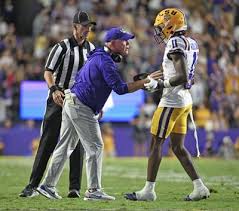
What do you do when you fire a coach in front of the whole country, hold a press conference about it, change the locks, take down his nameplate, and then—two weeks later—announce that you never actually fired him?
That, in essence, is the Brian Kelly problem.
LSU told the world Kelly was done the night after a brutal loss to Texas A&M, a game notable not just for the scoreboard but for the sideline footage that zoomed in on him grabbing and shoving his players and for all the world looking like he was about to square off for some MMA actions as their season slipped away.
The next day, LSU’s Athletic Director (since fired by the Governor of Louisiana) fired Kelly with the usual standards: “performance failure,” “expectations unmet,” “program going in the wrong direction,” “goals no longer aligned.” Kelly had a $54 million buyout clause in his contract and the AD shrugged it off with a “we’ll work it out later with him.”
So, to recap, one of the most highly compensated college football coaches in the country lost a key matchup against #3 ranked Texas A&M 49-25 after leading 19-16 at the half, acted like an upset 10-year-old on the sidelines when the game was out of reach, was fired less than 24-hours later with the AD saying the parting was mutual and amicable.
That story lasted a week.
After the AD was fired, LSU changed the narrative. They announced that Kelly had not been “formally terminated” at all, that the AD who fired him probably did not have had authority to do so, that grounds for a for-cause termination might exist, that the whole thing needed to be re-litigated from scratch, and, oh, yeah, by the way if it’s for cause forget the $54 million contract buyout.
Just to ensure that they would inflame the situation as much as humanly possible this was communicated to Kelly and his advisors by a quick phone call… as one does when casually adjusting the status of a man’s career and tens of millions of dollars.
Kelly’s lawyers, understandably unimpressed, responded by filing a 48-page lawsuit that reads less like a contract dispute and more like a guided tour through procedural absurdity. You fired him. You said why. You offered settlements. You tried to negotiate. You changed leadership. The governor weighed in. The only people who didn’t get the memo that Brian Kelly was fired were the people now claiming it never happened.
LSU, facing public pressure and a governor openly blanching at the idea of cutting another nine-figure check tied to football, is now trying to reverse engineer a “for cause” termination. Not because Kelly suddenly violated NCAA gambling rules or committed moral turpitude, or even that he was abusive to his players in close-ups on national TV but because… well, there’s probably $54 million other reasons that don’t fall under ‘for cause’.
So, the university has adopted what can only be called the Schrödinger’s Termination Doctrine: Kelly was fired but not fired; relieved of duty but not terminated; publicly dismissed, but technically still standing in some contractual purgatory where authority, timing, and paperwork might save LSU fifty-odd million dollars. One thing that is certain, Kelly was nowhere near LSU’s loss to Alabama the Saturday after his non-termination termination.
If this were any ordinary employment situation—CEO, hospital administrator, plant manager—you’d be talking about material breach without even finishing your coffee. You can’t announce a termination, negotiate post-termination settlements, then claim the termination never happened because you’ve changed your mind about how expensive it feels.
But this is college football in 2025 and not much makes sense. {See: Kiffin, Lane, Ole Miss Ultimatum).
Kelly’s contract spells out “for cause” (we know, of course, because as the highest paid Louisiana state employee his contract is very public) with clarity: serious NCAA violations, criminal activity, moral turpitude, sustained misconduct. Losing games is not on the list. Being unpleasant on the sideline, unless it somehow rises to “serious disrespect for the mission of LSU,” is not suddenly a retroactive contract terminator. And notably, LSU itself admitted—publicly, repeatedly—that this was about performance, not misconduct.
The lawsuit argues what any first-year contracts student would mutter under their breath: you don’t get to discover “cause” after the termination, particularly when you already explained the termination to the world in clear, performance-based language. You don’t get to fire first, negotiate second, and then invent reasons third once the buyout number starts echoing through the governor’s office.
Kelly isn’t really fighting about whether he should have been fired. He’s fighting about the rules LSU itself agreed to. LSU isn’t really arguing misconduct. It’s arguing math.
And somewhere between “not formally terminated” and “we believe grounds for cause exist,” the concept of reality has taken a knee.
Which might be the only thing on that field this season that actually went down cleanly.
Oh, and by the way, if you’re an employer and you take anything from this article take this: watch your words when terminating anyone. The major networks may not be covering your words but there are iPhones and … well, you know, things have a way of being immortalized that doesn’t involve ESPN.
Loss of Oomph

There are ambitious lawsuits, desperate lawsuits, creative lawsuits, and then there are lawsuits that make every lawyer in the room quietly stare at their shoes and ask themselves how this ever made it past the initial consult.
Ronald Perelman’s claim that five museum-quality paintings were “damaged” because they lost their “oomph” is solidly in that last category.
After a 2018 fire at his Hamptons estate, Perelman’s holding companies demanded roughly $400 million from his insurers for five works that were never touched by flames or water—two Warhols, two Ruschas, and a Cy Twombly. No scorching. No charring. No visible harm.
A quick aside about that $400 million valuation. It comes from Perelman and he didn’t make up the numbers while the East Hampton Fire Department was dousing the last embers. He always set the value of this collection—for sellers, buyer, the galleries, museums, and the insurance companies. No one—sellers, buyers, galleries, museums, and, yes, the insurance companies—ever asked for a second opinion.
Back to the lawsuit: Perelman’s theory was that smoke, humidity, and heat (despite the fact these paintings were far from the fire and protected behind state of the art, sealed frames) had somehow dulled the paintings “spirit, softening their vibrancy,” and “robbing them of that ineffable quality that separates art from expensive décor.” This despite the fact there was no discernable damage to any of them.
Perelman’s lawyer took this argument to another level, an even more audacious one: the insurance policies allowed his client to recover the full scheduled value of the works—values the insurers had accepted for years—even if the damage was merely “nominal.” Not destroyed. Not structurally compromised, just… diminished at some indefinable gut level.
The rest of the theory was simple: the insurers agreed to the astronomical valuations, charged enormous premiums without blinking, and therefore should now comply with the demands of the billionaire art connoisseur’s extensive experience.
In other words, Perelman wasn’t just saying the paintings lost their “oomph.” He was saying that if they lost even a whisper of it, the carriers owed him the full nine-figure check they happily wrote into the policy when times were good and premiums were flowing.
The problem, of course, is that courts are not in the business of insuring vibes. Justice Joel Cohen wasn’t persuaded, rejected the argument outright, and dismissed the case, finding no perceptible, material damage and nothing traceable to the fire. The legal system, at least for now, drew a hard line between actual harm and buyer’s remorse dressed up as existential disappointment.
Somewhere, an underwriter sighed in relief. And somewhere else, a lawyer finally admitted to themselves that “lost its sparkle” probably should have raised an eyebrow long before it reached a courtroom.
But the broader tension remains. For years, the insurers treated Perelman as what he was: a blue-chip collector with museum-grade taste and the means to back it up. They let him set the numbers. They priced the risk accordingly. Then, when he tried to cash in on his authority, they suddenly were skeptical—apparently for the first time.
It’s why this case existed at all—not just because of artistic ego, but because both sides helped build a system where subjective value was treated like objective fact, right up until someone tried to enforce it.
The underlying question lingers: when you let a client define reality for long enough, can you really act shocked when they expect you to honor it?

Don’t Miss an Issue
Haven’t subscribed yet? Agree with Homer? Then don’t miss another issue, subscribe now. And . . . if you know someone who may enjoy this, please feel free to forward this issue to them.