
Happy New Year!
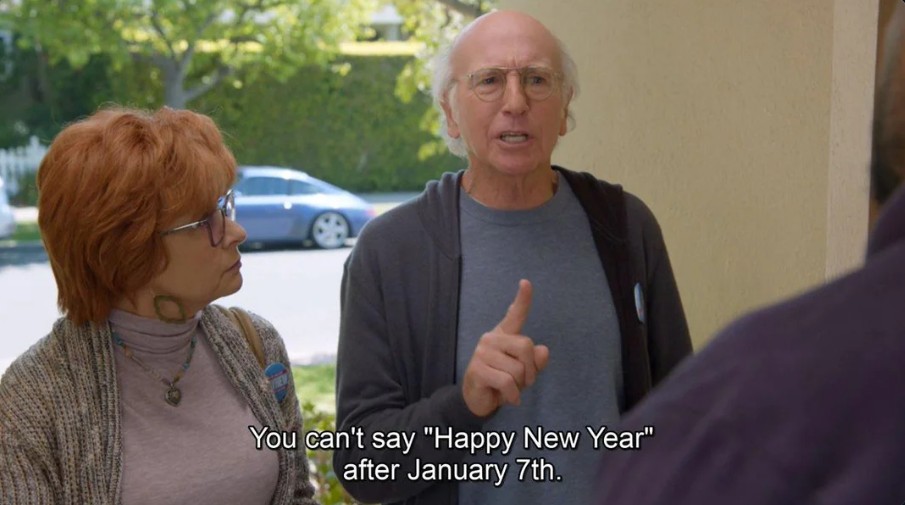
We’re pushing Larry David’s statute of limitations for saying “Happy New Year” but we’ll chance it: Happy New Year!”
On the other hand, what’s it matter? Both Larry David’s deadline and New Year’s Day itself are arbitrary. After all, over two billion people on planet Earth celebrate the New Year on a date other than January 1st.
Actually, until 1582, everyone on earth celebrated New Year’s on a date not January 1st. For centuries, the western world operated on the calendar devised by Julius Caesar—the Julian Calendar. A great effort for 45 B.C., but Caesar (or more accurately, his Greek mathematicians) couldn’t account for the Earth’s refusal to align itself with round numbers. By the early 16th century, the calendar was so far off that the spring equinox had gone rogue, wreaking havoc on Easter calculations.
Enter Pope Gregory XIII. In 1582, he decided to change the calendar and make it more accurate. He (or more accurately, his scientists) went medieval on the Julian calendar. They axed ten days from October that year—October 4th was followed by October 15th, the days in between never existed except that they, of course, did. They introduced a new leap year rule: every four years, except centennial years unless divisible by 400. It’s simpler than it sounds and, to give the Pope his due, it works, the new calendar only loses 26 seconds a year.
Lastly, almost as an afterthought, they moved New Year’s Day from March 15th to January 1st. Because why not? This would be a good place to note that the greatest power on earth, the British Empire, didn’t adopt the new calendar until 1752 which meant that a chunk of the world, including the American Colonies, celebrated New Years on March 15th—either over three months late by the rest of Europe’s standards or less than nine months early depending on one’s viewpoint.
The French quickly adopted the Gregorian calendar in 1584, then ditched it in 1792 and celebrated New Year’s on September 22nd. Napoleon switched them back to January 1st in 1806.
Here’s the thing: New Year’s Day is utterly arbitrary. January 1st isn’t any more meaningful than October 15th or March 15th or February 6th or September 22nd. Those are just the dates that someone, somewhere, sometime, decided to slap “Happy New Year!” on.
You can start the—or ‘a’—“New Year” anytime you want it to.
About the resolutions you made December 31st, 2023, and broke for… reasons, and are thinking about resurrecting again tonight: so, what?
About the big life decisions—like ending an unfulfilling relationship, starting therapy, starting a business, or finally doing business or estate planning—you’ve been putting off until the ‘perfect day’ but will probably [read: definitely] miss starting this week: so, what?
January 1st is an arbitrary date established by a Pope and his Jesuit advisors who lived during the Renaissance, disregarded equally by the Thirteen American Colonies and French Revolutionaries and never followed by billions of Africans and Asians.
Change, though, isn’t about dates on a calendar; it’s about you. A resolution made on January 1st is no more valid than one made on March 2nd.
The big lie of January 1st is that if you don’t start now, you’ve missed your shot. That’s nonsense. Every day is a chance to take stock, plan, and move toward the life you want.
Happy New Year 2026… unless you’re reading this on January 8th, in which case, “Eh, we’re sorry.”
Quote of the [last] Year
“The year is over, I am heartily glad of it and hope you nor America will ever be plagued with such another.”
~ Letter from New Jersey’s Robert Morris to George Washington, January 1, 1777
70th Anniversary
December 31st was the 70th anniversary of the release of Looney Tunes’ iconic One Froggy Evening. If you’ve never seen the whole thing, well, you’ve missed one of the great cautionary tales of the 20th Century. The story of Michigan J. Frog is one for our times as well.
It Has Everything

Coming Attractions: every once in a while a situation pops up that’s pretty much the Holy Grail for law-firm newsletter writers — a matter that covers perhaps a dozen different practice areas, including litigation, is chock full of oversized personalities and a few almost-celebrities, and promises to last for years with many, many plot twists.
The high-rise on Billionaires’ Row in New York, 432 Park Avenue, is one such situation and then some.
At its simplest, it’s about a luxury condominium tower that was supposed to be perfect. Instead, it’s become a slow-motion collision between ambition, aesthetics, engineering limits, money, and human behavior. Developers, architects, engineers, condo boards, owners, lenders, insurers, regulators, and a rotating cast of consultants are now circling the same set of facts from different angles, each with something to protect and something to lose.
There are warnings in emails, decisions made under time pressure, fixes proposed and rejected, repairs attempted and disputed, and enough paper to keep discovery fights alive for years.
For us, it’s the gift that will keep on giving. Construction defects and professional liability. Contract drafting and risk allocation. Disclosure obligations and resale fallout. Negligence. Debt. Mortgage fraud. Condo governance, fiduciary duties, and internal power struggles. Insurance coverage battles. Financing disasters. Regulatory oversight (or lack thereof). Litigation threats.
Then there’s the building itself – either a modern luxury building with lavish amenities or well on its way to the dystopia of J.G. Ballard’s novel High Rise, depending on who you ask.
It all started because a designer wanted the whitest possible white concrete to ‘make a statement’ . . . but more on that next issue.
“Doesn’t Count!”

If you haven’t seen Wills & Trusts’ “Doesn’t Count” ads . . . well, you’re not watching any live TV, they’re everywhere.
They’ve won a ton of advertising awards and are, admittedly, a great hook for selling DIY wills. The ad is dead on – it doesn’t count if you just talk about giving your vintage car to your grandson or promise jewelry to a favorite niece, or ask your friends to be guardians of your kids if anything happens to you. Talking, indeed, doesn’t mean squat. So do it right – which is not online.
Here’s what the ad misses: in this arena, only two things matter—what the courts recognize and what institutions will accept.
You can use their program (while uploading all your family and financial information) write the most heartfelt will on the planet and still have your heirs wind up with nothing like what you intended.
The ‘law’ – not to mention probate courts – is hardly simple. They need to know that the right people were in the room, the right words on the page, the right witnesses actually witnessing right down to who watched whom sign and whether those folks stand to inherit or be executors or trustees. Miss something here and the court won’t take it or, worse, it opens a lane for everything you just laid out to be challenged by someone who you definitely wanted nowhere near your estate.
Oh, and here’s another thing – if there’s a problem a website on your laptop makes a really lousy witness.
Two quick realities the ads skip. First, templates are blunt instruments. They don’t know your state’s quirks, your kids’ needs, your LLC’s transfer restrictions, or that your life insurance points to an ex from 2014. They won’t warn you that a “simple” gift to a child with a disability can nuke benefits, or that your trust is an empty box until you retitle the house and accounts. They’ll happily spit out boilerplate while your beneficiary forms quietly contradict every page.
Second, websites aren’t counsel. A chatbot can’t tell you your witnesses are conflicted, that your remote notarization isn’t valid where the property sits, that your business operating agreement trumps your will, or that your “digital vault” clause is useless without real passwords and an inventory. It won’t chase a bank to accept the paperwork, won’t fix funding, and won’t stand next to your executor when a clerk says, “Nope.”
Finish the job in the real world. Sit down with a lawyer who practices where you live, execute the documents with actual humans who aren’t beneficiaries, fund the trust, fix the beneficiary forms, and line everything up so banks, title companies, and courts say “yes” without a hiccup. That is what counts.
Don’t Miss an Issue
Haven’t subscribed yet? Agree with Homer? Then don’t miss another issue, subscribe now. And . . . if you know someone who may enjoy this, please feel free to forward this issue to them.