
A Sport of Centimeters

A week before the Winter Olympics started in Italy, scandal rocked the world of sports. Okay, maybe not the world but . . . well, more like a highly specialized niche of the sports world. And Norway.
It may be the most subtle sports cheating scandal of all time. It certainly isn’t Astros-banging-on-garbage-cans loud but its repercussions are certainly 1919-Black-Sox-throwing-the-World Series serious for all involved in the hyper-technical, insular world of ski jumping.
If you missed it here’s what happened: Norway’s coaches were caught on video slipping forbidden stitching into race suits after they had already been inspected.
A few aerodynamically sound, almost invisible threads in the crotch. Simple physics (at least for rocket scientists): tighten the air where it matters, shave drag and use the ensuing tiny fraction of lift for surprisingly more time in the air resulting in a longer jump. In a sport measured in centimeters, a fraction is the difference between a medal and a quiet plane ride home.
The tweak was microscopic — a few hidden stitches that changed how air moved across fabric and body. The math is incontestable; there’s even a formula that explains it all: L ≈ ½·ρ·v²·S·Cᴸ.
But, of course, there are rules about the construction and fit of ski jump suits – as anyone who’s ever watched Eddie the Eagle (the Rudy of ski jumping) knows. Every jumper, their suit, helmet, gloves, boots, and skis are carefully inspected before every competition.
Here’s the thing that really hits us: a nearly invisible alteration had long-lasting results that were, unknowingly at the time, devastating to others . . . and now you know where I’m going with this.
The same basic physics applies in business disputes, even when nobody is screaming and nothing is “wrong” on paper yet.
Most business blowups do not start with a dramatic betrayal. They start with drift.
Somebody gets casual about authority. A promise gets made on a call and never recorded. A vendor gets paid “this one time only” without a proper invoice because it is easier. A partner starts uses company credit cards for borderline business expenses – or not. Records get a tad sloppy. Corporate formalities get skipped. A “temporary” arrangement becomes the new normal, and then everyone is shocked later when the normal becomes the evidence.
Sometimes it is governance. Meetings stop happening. Minutes stop being kept. Decisions get made in hallways, not resolutions. The ownership percentages stay the same, but the control dynamics shift quietly. Sometimes it is contracts. The deal terms are “understood,” and then memory becomes the only document anyone can find.
Sometimes it is employment. Roles evolve, titles get handed out informally, compensation changes without clean documentation, and then the company discovers it has created expectations it did not intend to create.
Sometimes it is litigation posture. You think you are “being reasonable” by letting a problem slide, until you realize you have been feeding the other side exactly what they needed: time, leverage, and a record of you not objecting.
The little stuff matters. The earlier you catch the stitch, the more choices you have. The later you catch it, the further behind you are.
If something in your business feels “off,” that’s the time to talk to counsel, map the risk, and decide whether the fix is a clean contract, a governance reset, a restructuring, a buyout, or a lawsuit that is better filed now than later.
Wondering why things went south after the competition has ended is not the way to go.
A 50-50 Ball . . . and Common Sense

On September 19, 2024, Shohei Ohtani had quite the day in Miami. He entered the day with 49 stolen bases and 48 homeruns. No one in baseball history had ever hit 50 home runs and stolen 50 bases in the same season.
In the first inning, he doubled and stole third base for number 50. In the second inning he singled and stole number 51. He doubled in the third, then hit his 49th homerun in the sixth. In the seventh he hit a 1-2 pitch to the opposite field left field stands for number 50. Mayhem in the stands ensued as the few Marlin fans recognized the significance and potential value of the ball. They were probably still fighting over it when Ohtani hit his 51st an inning later. (Yes, he went 6-6 with 3 homeruns, 2 doubles, and a Dodger record 10 RBIs).
Three men got to the ball at once. One eventually sprinted out of the park with it. The other two immediately claimed they had had it first and lost it in the scrum after they “were assaulted.”
Everyone lawyered up. Cease-and-desist letters flew. In the middle of it all, one person behaved like an adult: an auctioneer.
The man who had possession, contested as it was, of the ball, Christian Zacek, brough the ball to Ken Goldin for consignment. Golden authenticated it – easy as it was all on video: the hit, the scrum, the escape – and put it up for auction. For a solid two days before cease-and-desist letters from the other two claimants, Max Matus and Joseph Davidov, arrived in tandem to shut it down.
This is where stories like this go off the tracks and dissolve into years of litigation. Golden had seen it happen. He was not going to watch it happen for this once-in-a-lifetime item (sure, Ohtani could do it again but since he is back pitching as well, he has vowed to take it easy on the basepaths moving forward).
Goldin was very aware of the sports memorabilia industry’s cautionary tale: Barry Bonds’ record-setting 73rd home run ball in 2001 was tied up in litigation and didn’t sell until June 2003 just as Bonds’ steroid use was coming to light. It sold for $450,000—pocket change compared to what other baseballs were pulling in.
Goldin forced a meeting with all three and asked the most important question: do one of you want to keep this ball, or do you want to turn it into as much money as possible?
They wanted the money.
So he explained the ‘historic-baseball-for-sale facts of life:” sell it now while it’s hot, or wait and all kinds of things (a healthy Ronald Acuna Jr?) could happen to drive the price down.
Goldin told them to let the market set the price immediately and let the courts decide who owns what later. Goldin’s proposal would preserve the value of the asset while the ownership dispute remained unresolved. They agreed.
It worked. The ball sold for a record $4.39 million to a Taiwan-based investment firm. Goldin took his commission—$792,000 (another lesson, most of the time the adult in the room gets paid). The remaining proceeds (roughly $3.6 million) are in trust while the three claimants fight it out in Miami-Dade County court after mediation in December failed miserably.
What Goldin didn’t tell the claimants was that the dispute itself helped. The fight attracted attention, and attention attracts bidders. The ball didn’t sell in spite of the litigation cloud—it likely sold higher because of it.
This is one of those stories that sounds like sports nonsense until you realize it is contract and litigation strategy dressed up as a baseball.
Apple’s Paperwork
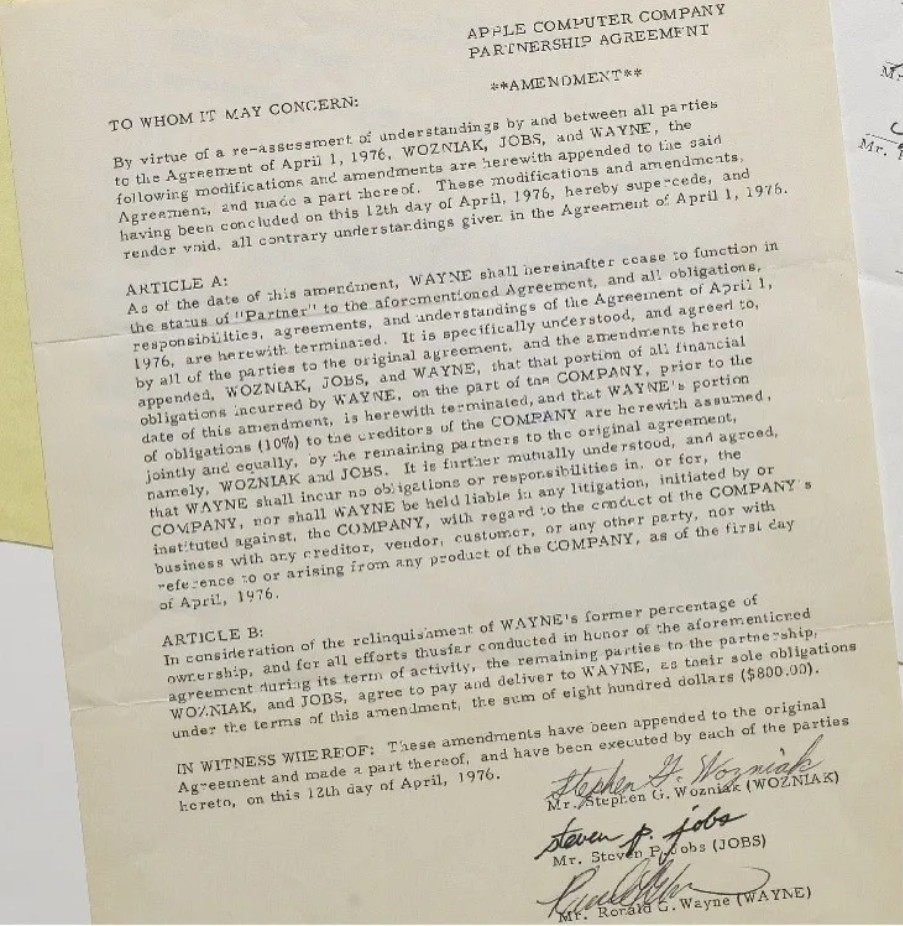
Apple’s original Apple Computer Company founding papers — the three-page partnership agreement signed on April 1, 1976 by Steve Jobs, Steve Wozniak, and Ronald Wayne — sold at Christie’s auction on January 23, 2026 for about $2.5 million. The documents were offered as part of the “We the People: America at 250” sale in New York, with pre-sale estimates between $2 million and $4 million.
These are the actual partnership documents from 1976, signed by Steve Jobs, Steve Wozniak, and Ron Wayne—the paperwork that created Apple Computer. They list the original ownership split: 45 percent to Jobs, 45 percent to Wozniak, and 10 percent to Wayne.
If that last name does not ring a bell, it is because Ron Wayne sold his stake twelve days later for $800. He received another $1,500 the following year and walked away. At the time, he was sure he was the adult in the room, worried that the young company’s growing debt and day-to-day chaos would ruin him.
Had he kept that 10 percent, it would be worth an unfathomable amount today.
He has always maintained that he has never regretted his decision.
What he did regret was not keeping his copy of the founding documents with original signatures.
So yes, keep your corporate records. One day, they may be worth a fortune. In the meantime, they could help you out of a legal morass.

Don’t Miss an Issue
Haven’t subscribed yet? Agree with Homer? Then don’t miss another issue, subscribe now. And . . . if you know someone who may enjoy this, please feel free to forward this issue to them.